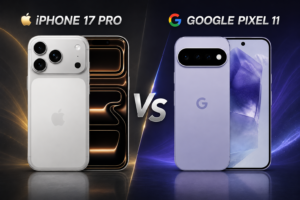


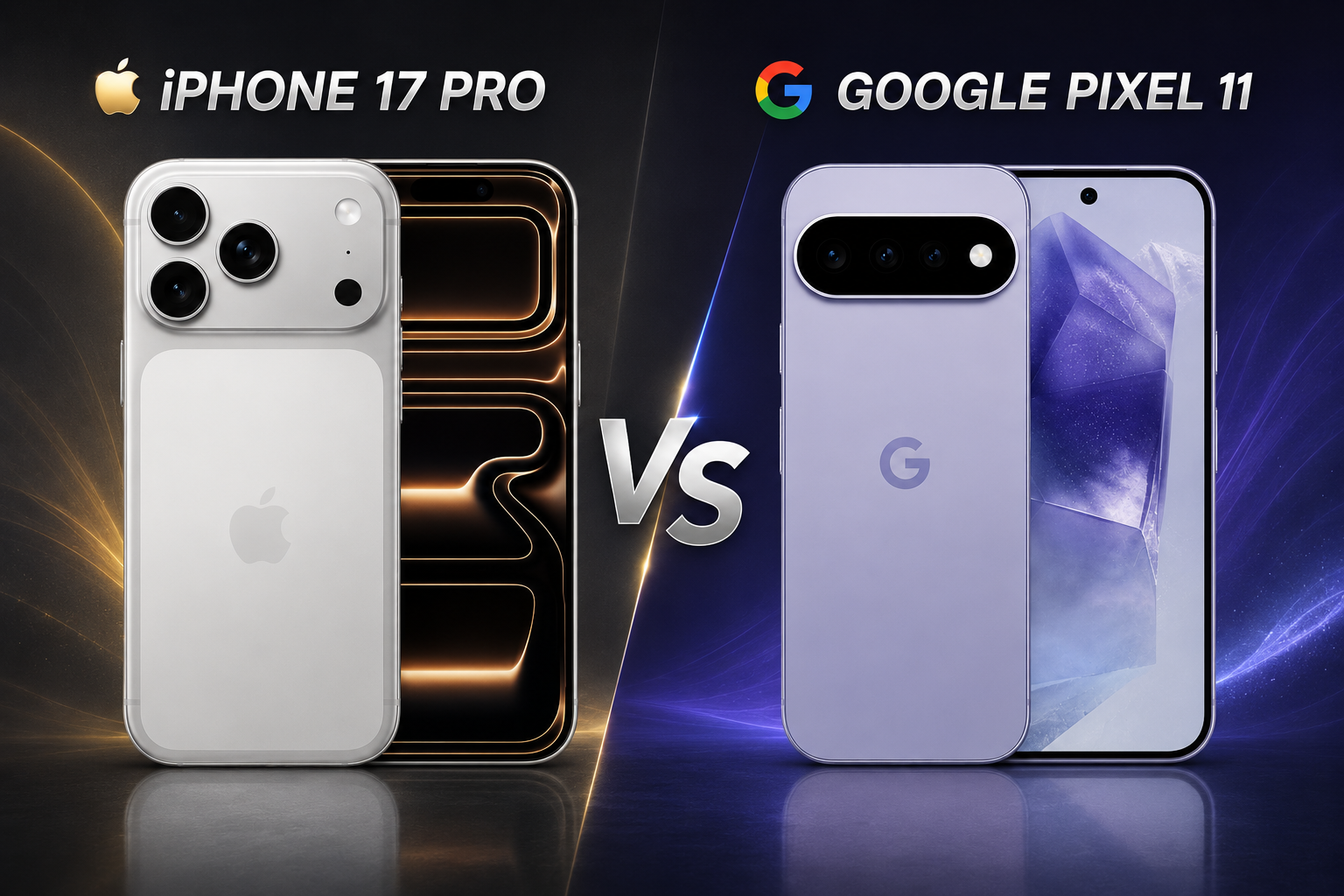
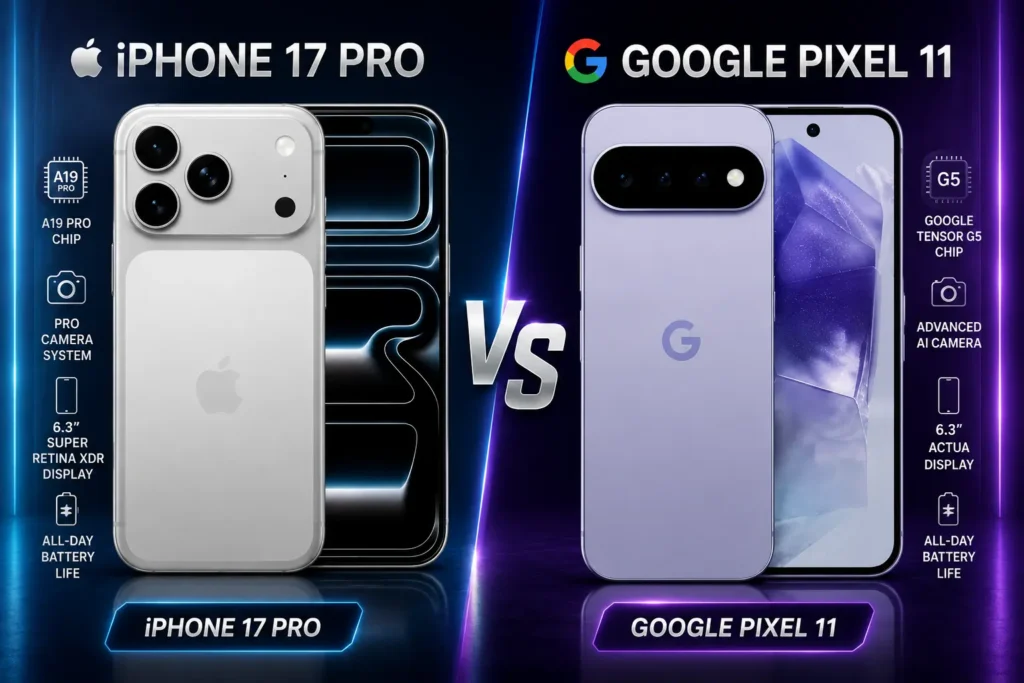
Two of 2026’s biggest flagship names are now going head-to-head, and everyone wants to know the same thing: in a Pixel 11 vs iPhone 17 Pro face-off, which one actually deserves your money?
On one side, you have Google’s Pixel 11, a phone built entirely around Gemini AI, computational photography, and a chip designed specifically to think faster than it clicks a photo. On the other, Apple’s iPhone 17 Pro, an aluminum-and-titanium powerhouse built for raw performance, video, and an ecosystem that just refuses to let you leave.
Both phones are being marketed as “smart” — but smart in very different ways. One is smart because of software intelligence baked into every corner of the OS. The other is smart because of tightly engineered hardware and a chip that outperforms almost everything else on the market.
In this detailed comparison, we’ll break down the Pixel 11 and iPhone 17 Pro across display, performance, camera, battery, AI features, software support, and price in India — so that by the end, you’ll know exactly which phone fits your needs.
Pixel 11 vs iPhone 17 Pro: Quick Specification Comparison
| Specification | Google Pixel 11 | Apple iPhone 17 Pro |
|---|---|---|
| Display | 6.3″ OLED, 120Hz, up to 3,000 nits peak | 6.3″ Super Retina XDR OLED, ProMotion 120Hz, up to 3,000 nits outdoor, Always-On |
| Chipset | Google Tensor G6 (with Titan M3 security) | Apple A19 Pro (with vapor chamber cooling) |
| RAM | 12GB | 12GB |
| Storage Options | 256GB / 512GB | 256GB / 512GB / 1TB |
| Rear Camera | 48MP main (f/1.7, OIS) + 13MP ultrawide + 10.8MP telephoto (5x optical) | 48MP main + 48MP ultrawide + 48MP telephoto (8x optical-quality zoom) |
| Front Camera | 10.5MP | 18MP Center Stage |
| Battery | 4,985mAh, 30W wired, 25W Qi2.2 wireless | Not officially disclosed, rated for all-day and extended video playback |
| Build | Aluminum frame, Gorilla Glass Victus 2 back | Heat-forged aluminum unibody, Ceramic Shield 2 front & back |
| Operating System | Android 17, 7 years of OS updates | iOS 26, typically 5-6 years of updates |
| Starting Price (India) | ₹89,999 | ₹1,34,900 |
At first glance, the price gap alone tells you a lot. The Pixel 11 is priced almost ₹45,000 lower than the iPhone 17 Pro, which immediately changes how you should think about this comparison — it’s not just flagship vs flagship, it’s also value vs premium.
Design and Build Quality
Google has given the Pixel 11 a noticeably slimmer camera bar this year — over 40% thinner than the outgoing Pixel 10 — sitting on a satin-finished aluminum frame with a Gorilla Glass Victus 2 back. It’s available in fresh shades like Frost, Hibiscus, Pistachio, and Obsidian, and at 197 grams with an 8.6mm profile, it’s genuinely comfortable to hold for long stretches.
The iPhone 17 Pro takes a different route entirely. Apple has ditched the titanium frame from last year’s Pro models and moved to a heat-forged aluminum unibody, laser-welded with an internal vapor chamber for better thermal performance during gaming and heavy tasks. Up front, there’s Ceramic Shield 2, offering 3x better scratch resistance, while the back gets a Ceramic Shield layer that’s 4x more crack-resistant. It comes in Silver, Deep Blue, and a striking Cosmic Orange finish.
Both phones feel premium, but they represent two different design philosophies. The Pixel 11 leans into a soft, colourful, everyday-carry aesthetic, while the iPhone 17 Pro leans into industrial toughness and thermal engineering — a phone clearly built to be pushed hard without throttling.
Display Showdown
Both phones share an identical 6.3-inch screen size, and on paper, they look almost like twins: 120Hz refresh rates, OLED panels, and peak brightness levels hovering around the 3,000-nit mark.
The Pixel 11’s screen is protected by Gorilla Glass Victus 2 and delivers punchy colours with Google’s usual vibrant, slightly warm calibration. The iPhone 17 Pro’s Super Retina XDR display, on the other hand, adds an Always-On mode and a new anti-reflective coating that Apple claims doubles outdoor contrast compared to last year — genuinely useful if you’re often checking your phone under harsh sunlight, which matters a lot in Indian conditions.
If you’re someone who spends hours outdoors or does a lot of content consumption in bright light, the iPhone 17 Pro’s anti-glare coating gives it a slight practical edge. For everyday indoor use, both displays are excellent and unlikely to disappoint.
Performance: Tensor G6 vs A19 Pro
This is where the two phones philosophically diverge the most.
Apple’s A19 Pro chip is a raw performance monster. It comes with an extra GPU core over the standard A19, is paired with a dedicated vapor chamber cooling system, and continues Apple’s multi-year streak of leading every single-core and multi-core benchmark in the smartphone world. If you’re a mobile gamer, edit 4K video on the go, or run demanding pro apps, the A19 Pro simply has no real competition at this price point.
Google’s Tensor G6, meanwhile, isn’t built to win benchmark wars — it’s built to make AI feel instant. Google says the new chip delivers 50% more TPU compute than the previous generation, letting on-device Gemini Nano tasks run up to 3.5x faster while consuming significantly less battery. It’s also backed by the new Titan M3 security co-processor, adding another layer of protection against advanced attacks, including future quantum-computing threats.
So the honest answer here is: if raw horsepower and gaming performance matter most to you, the iPhone 17 Pro wins comfortably. But if you care about how quickly your phone can summarize a webpage, transcribe a call, or edit a photo using AI — the Tensor G6 is arguably the more “intelligent” chip for real-world daily use.
Camera Comparison: Who Takes Better Photos?
Camera performance is usually the single biggest deciding factor for most buyers, so let’s break this down properly.
Google Pixel 11 Camera
- 48MP main camera (f/1.7, 1/1.56-inch sensor, OIS) — 56% more light sensitivity than before
- 13MP ultrawide lens (f/2.2)
- 10.8MP telephoto lens with 5x optical zoom, Super Res Zoom up to 30x
- 10.5MP front camera with a 95-degree field of view
Google’s real strength has never really been about hardware megapixels — it’s about computational photography. Features like Magic Capture, Instant Night Sight, Add Me, Auto Best Take, and Zoom Enhance make the Pixel 11 exceptional at producing “final” photos straight out of the camera, without needing to edit anything later. Low-light photography, in particular, continues to be one of the Pixel line’s biggest strengths.
iPhone 17 Pro Camera
- Triple 48MP Fusion camera system — Main, Ultra Wide, and an all-new Telephoto
- 8x optical-quality zoom, the longest ever on an iPhone
- 18MP Center Stage front camera with landscape framing in portrait orientation
- ProRes RAW, Apple Log 2, and 8K-capable video recording
The iPhone 17 Pro’s biggest leap this year is video. Between the new telephoto lens, Apple Log 2 support, and the vapor-chamber cooling that prevents overheating during long 4K/8K recording sessions, this is unmistakably the phone built for content creators and filmmakers who shoot video as much as they shoot photos.
Verdict: For still photography, especially low-light and everyday shots, the Pixel 11 has a slight computational edge. For video creators and anyone who wants longer optical zoom, the iPhone 17 Pro is the clear winner.
Watch this video for live camera test :-
Battery Life and Charging
The Pixel 11 packs a 4,985mAh battery with 30W wired PPS fast charging and 25W Qi2.2 wireless charging — a meaningful jump from previous generations, and Google claims over 30 hours of typical use on a single charge.
Apple hasn’t officially published the iPhone 17 Pro’s exact battery capacity, but the company claims a significant leap in battery life this year, aided by the more efficient A19 Pro chip and improved thermal management. Real-world reviews suggest all-day battery life with room to spare, particularly for the Pro Max variant.
Charging speeds have historically favoured Android phones, and that trend continues here — the Pixel 11 charges noticeably faster on paper, especially with a compatible 30W+ charger.
AI Features: Gemini vs Apple Intelligence
This might be the single most important differentiator in 2026.
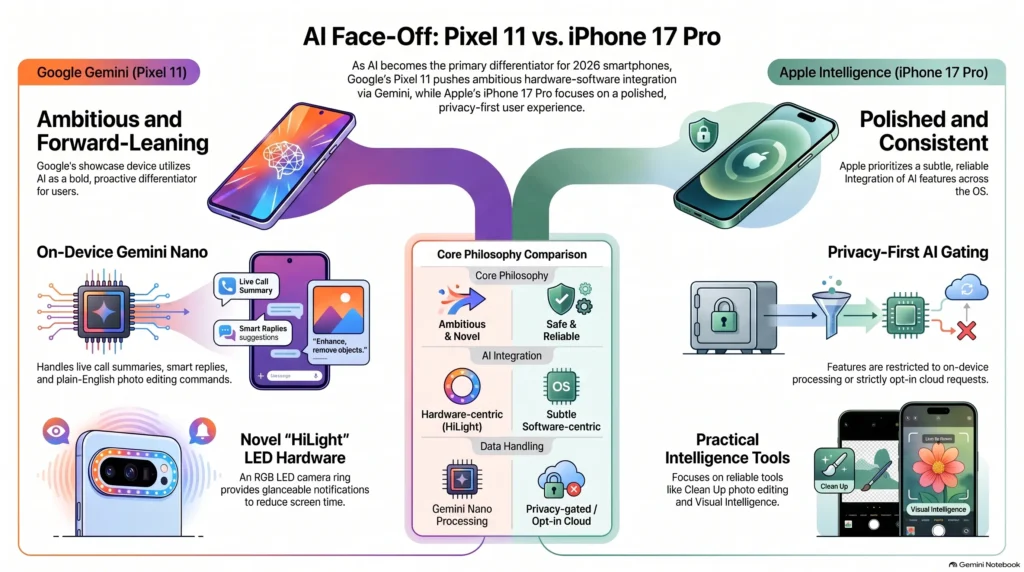
The Pixel 11 is essentially Google’s showcase device for Gemini. On-device Gemini Nano handles tasks like live call summaries, smart replies, and photo editing instructions typed in plain English. The new HiLight feature — a ring of RGB LEDs built into the camera bar — glows in different colours and patterns for notifications, letting you glance at context even when your phone is face-down. It’s a genuinely novel way of using ambient hardware to reduce screen time.
Apple’s answer is Apple Intelligence, integrated more subtly across iOS. Features like Clean Up (for removing unwanted objects from photos), Visual Intelligence, and Live Translation are polished and reliable, but Apple has generally taken a more conservative, privacy-first approach, keeping many AI features gated behind on-device processing or opt-in cloud requests.
If AI is the main reason you’re upgrading, the Pixel 11 currently feels like the more ambitious and forward-leaning device, while the iPhone 17 Pro plays it safer but more consistently.
Software Support and Longevity
Google now promises 7 years of major Android OS updates and security patches for the Pixel 11 series — a massive commitment that essentially matches Apple’s own update timeline for the first time in Pixel history.
Apple typically supports iPhones with major iOS updates for 5-6 years, though real-world software support (including security patches) has historically stretched even longer for older iPhone models.
This is a big shift. In previous years, Apple’s long-term software support used to be one of its clearest advantages over Android. With the Pixel 11’s 7-year promise, that gap has effectively closed.
Price in India: Which Offers Better Value?
| Model | Storage | Price in India |
|---|---|---|
| Google Pixel 11 | 256GB | ₹89,999 |
| Google Pixel 11 | 512GB | Higher tier |
| iPhone 17 Pro | 256GB | ₹1,34,900 |
| iPhone 17 Pro | 512GB | ₹1,54,900 |
| iPhone 17 Pro | 1TB | ₹1,74,900 |
The price difference here is significant — nearly ₹45,000 separates the two phones at their base storage tier. That’s not a small gap, and it fundamentally changes the buying decision. The Pixel 11 positions itself as a genuine flagship at a relatively more accessible price, while the iPhone 17 Pro sits firmly in premium territory, justified by its raw performance, camera versatility, and Apple’s ecosystem lock-in.
If you’re comparing pure value for money, the Pixel 11 pulls ahead by a wide margin. If budget isn’t a major concern and you’re already inside the Apple ecosystem — with a MacBook, AirPods, or Apple Watch — the iPhone 17 Pro’s premium pricing becomes easier to justify.
Pixel 11 vs iPhone 17 Pro: Who Should Buy What?
Choose the Google Pixel 11 if you:
- Want the most advanced on-device AI experience right now
- Care deeply about computational photography and low-light shots
- Want guaranteed long-term software support (7 years)
- Are looking for better value for money
- Prefer a clean, stock Android experience
Choose the iPhone 17 Pro if you:
- Want the fastest, most powerful mobile chip available today
- Shoot a lot of video content or work in ProRes/Apple Log workflows
- Are already invested in the Apple ecosystem
- Want the longest optical zoom and most versatile Pro camera system
- Prioritize build durability and thermal performance under heavy use
Final Verdict
So, which phone is actually “smarter”? It genuinely depends on how you define smart.
If smart means an AI assistant that understands context, summarizes your day, and edits your photos through natural language, the Pixel 11 is ahead of the curve right now. If smart means raw processing power, best-in-class video capabilities, and rock-solid ecosystem integration, the iPhone 17 Pro remains unbeatable.
For most Indian buyers looking for flagship performance without a flagship-sized dent in their wallet, the Pixel 11 makes a compelling case as the smarter overall package in 2026. But if money isn’t the deciding factor and you want the absolute best camera hardware and performance ceiling money can buy, the iPhone 17 Pro is still worth every rupee.
Whichever you choose, 2026 has proven one thing clearly: the smartphone “smart” race is no longer just about specs on paper — it’s about how intelligently a phone actually helps you live your day.
Frequently Asked Questions (FAQs)
1. Is the Pixel 11 cheaper than the iPhone 17 Pro in India? Yes. The Pixel 11 starts at ₹89,999, while the iPhone 17 Pro starts at ₹1,34,900 — a difference of nearly ₹45,000 for the base storage variant.
2. Which phone has a better camera, Pixel 11 or iPhone 17 Pro? The Pixel 11 generally performs better in low-light and computational photography, while the iPhone 17 Pro leads in video recording, zoom range, and overall camera versatility.
3. Does the Pixel 11 support Gemini AI features? Yes, the Pixel 11 runs on the Tensor G6 chip with on-device Gemini Nano, enabling faster AI processing for tasks like call summaries, smart replies, and photo editing.
4. How long will the Pixel 11 receive software updates? Google has confirmed 7 years of major OS updates and security patches for the Pixel 11 series, matching Apple’s long-term software support commitment.
5. Which chip is faster, Tensor G6 or A19 Pro? The Apple A19 Pro comfortably outperforms the Tensor G6 in raw benchmark performance and gaming, while the Tensor G6 is optimized specifically for faster on-device AI tasks.
6. Is the iPhone 17 Pro worth the extra price over the Pixel 11? If you value top-tier performance, video recording capabilities, and are already using Apple devices, the extra cost is justified. If value for money matters more, the Pixel 11 is the smarter buy.
Which one are you leaning towards — the AI-first Pixel 11 or the powerhouse iPhone 17 Pro? Let us know in the comments below, and keep following Tipsi Tech for more in-depth smartphone comparisons.
Our Previous Posts :-
iQOO Z11 5G: Complete Specifications, India Price, Launch Date, and In-Depth Analysis
Why Smartphone Prices Are Increasing in 2026 (And Should You Buy Now or Wait?)
Best Phones Under 50,000 in 2026: Top Picks for Every Need
iQOO Z11 vs Motorola Edge 70 Neo: Which Mid-Range Phone Should You Buy?
Best Smartphone Under 20000 in 2026 – Top Picks with Full Details
Table of Contents
About The Author