



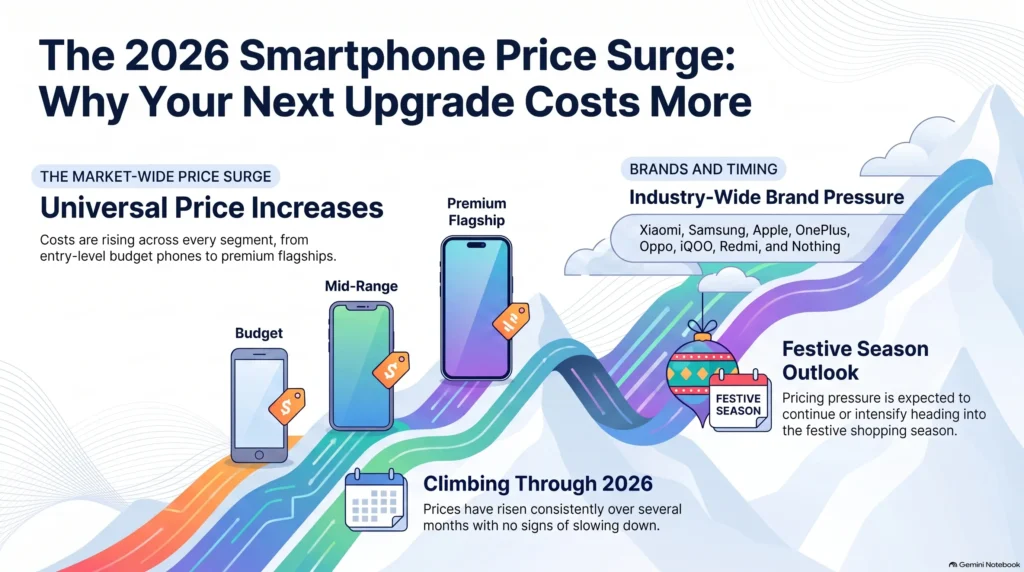
If you’ve been shopping for a new phone recently, you’ve probably noticed something frustrating: the same model that cost a certain amount a few months ago now costs noticeably more. You’re not imagining it. Across nearly every price segment — from entry-level budget phones to full flagships — smartphone prices in India have been climbing through 2026, and the trend shows no sign of slowing down before the festive season.
This isn’t a one-brand problem. Xiaomi, Redmi, Oppo, iQOO, OnePlus, Nothing, Samsung, and even Apple’s upcoming lineup are all being pulled into the same pricing pressure. In this guide, we’ll break down exactly why this is happening, which phones and brands are hit hardest, and — most importantly — whether you should buy your next phone right now or hold off a little longer.
The Real Reason Smartphone Prices Are Going Up in 2026
It’s tempting to assume this is just “inflation” or brands being greedy, but the actual cause is more specific: a global shortage of memory chips.
1. The RAM and Storage Shortage
Every smartphone needs two critical components that have nothing to do with the visible design or camera bump: RAM (for multitasking) and NAND flash storage (for saving your files and apps). Through 2026, the global supply of these memory chips has tightened dramatically, and manufacturers are paying far more to secure them than they were a year ago. That increased cost doesn’t stay with the chipmakers — it gets passed straight down to the phone you buy.
2. AI Data Centers Are Competing for the Same Chips
Here’s the part most buyers don’t realize: your smartphone is now competing with AI infrastructure for factory capacity. The same memory chip factories that supply phone brands also supply the massive server farms being built to power AI tools and cloud computing. As AI companies buy up memory chips in bulk for their data centers, there’s simply less supply left over for consumer electronics — and what remains costs more.
3. Currency and Import Cost Pressure
On top of the global chip crunch, Indian buyers are also feeling the effect of currency fluctuations and import costs on components, since most phones sold in India still rely heavily on imported parts even when assembled locally. Combined with the memory shortage, this has created a compounding effect on final retail prices.
Which Phones and Brands Have Been Affected
Almost no price bracket has been spared, but the impact looks different depending on where you’re shopping:
- Budget phones (under ₹15,000): Brands like Redmi, Oppo, and iQOO have quietly increased prices on multiple existing models, since budget phones run on tighter margins and can least absorb rising component costs.
- Mid-range phones (₹15,000–₹40,000): This is the segment feeling it the most visibly, as RAM and storage variants (like 8GB/128GB or 12GB/256GB) have become noticeably pricier than they were at launch.
- Flagships: OnePlus has already raised prices on its 15 series flagships, and upcoming launches like Samsung’s next Galaxy Ultra and Apple’s iPhone 18 Pro are both expected to carry higher price tags than their predecessors when they arrive.
Budget vs Flagship: Who Gets Hit Hardest?
It might seem like flagship buyers, who are already spending more, would feel this the least — but the opposite is often true in percentage terms. A ₹2,000–₹3,000 increase on a ₹15,000 budget phone is a much bigger jump proportionally than the same increase on a ₹70,000 flagship. If you’re shopping in the budget-to-mid-range segment (which most Indian buyers are), you’re likely to notice this hike the most.
Should You Buy a Phone Now or Wait?
This is the question everyone actually wants answered, and the honest response is: it depends on what you’re buying and why.
Buy now if:
- You need a phone urgently and can’t wait out an uncertain shortage timeline
- You’ve found a solid deal or bank discount on a phone that already fits your budget
- You’re eyeing a phone that’s already been out for a few months (older stock is less affected by fresh price hikes)
Wait if:
- You’re specifically interested in a phone that hasn’t launched yet (like the Pixel 11 series, iPhone 18 Pro, or OnePlus 16), since early pricing on new launches tends to be higher and may adjust once initial demand settles
- You’re flexible on timing and can hold out for festive-season offers, which often absorb some of the price pressure through bank cashback and exchange bonuses
- Your current phone still works fine and this is more of a “want” than a “need” upgrade
How to Save Money on a Phone Right Now

Even in a rising-price environment, there are a few practical ways to soften the impact:
- Buy previous-generation models. A phone launched 6–8 months ago often gets discounted to clear inventory, even while newer models in the same line get pricier.
- Watch for bank card offers. Instant discounts and no-cost EMI offers during sale events can offset a meaningful chunk of the hike.
- Use exchange offers aggressively. Trade-in value on your old phone effectively locks in today’s price rather than tomorrow’s.
- Avoid chasing the newest RAM/storage variant. If you don’t need 16GB RAM or 512GB storage, a lower variant of the same phone is far less exposed to the memory price hike.
- Track price history before buying, since some retailers quietly raise the “before discount” price to make a sale look bigger than it is.
Final Thoughts
The smartphone price hike hitting India in 2026 isn’t a marketing gimmick or brand-specific decision — it’s the direct result of a global memory chip shortage that’s being intensified by AI infrastructure demand, layered on top of currency and import pressures. If you’ve noticed your favorite phone getting pricier by the month, this is why.
The smartest move right now is to buy based on genuine need rather than fear of missing a deal, lean on festive offers and exchange programs where you can, and avoid overpaying for RAM or storage you won’t actually use.
If you’re currently comparing options within a fixed budget, check out our detailed picks for the Best Phones Under 50,000 in 2026, Best Smartphone Under 20,000 in 2026, and Best Camera Phones Under ₹25,000 — all recently updated to reflect current market pricing.
Frequently Asked Questions
Q1. Why are smartphone prices increasing in 2026? A global shortage of RAM and NAND storage chips, driven partly by AI data centers competing for the same manufacturing capacity, has pushed component costs up across nearly every phone brand.
Q2. Will smartphone prices go down later in 2026? It’s hard to predict exactly, but prices often ease slightly around festive sale periods due to bank offers and promotional discounts, even if the underlying component costs stay high.
Q3. Should I buy a budget phone now or wait? If you need a phone now and find a fair deal, buying now is reasonable — waiting won’t guarantee a discount, and budget phones are already seeing steady price increases.
Q4. Are flagship phones getting more expensive too? Yes. OnePlus has already raised prices on its 15 series, and upcoming flagships like the iPhone 18 Pro and next-gen Galaxy Ultra are expected to launch at higher prices than their predecessors.
Q5. How can I avoid overpaying for a phone right now? Stick to previous-generation models, use exchange and bank offers, and choose the RAM/storage variant you actually need instead of the highest one available.
About The Author